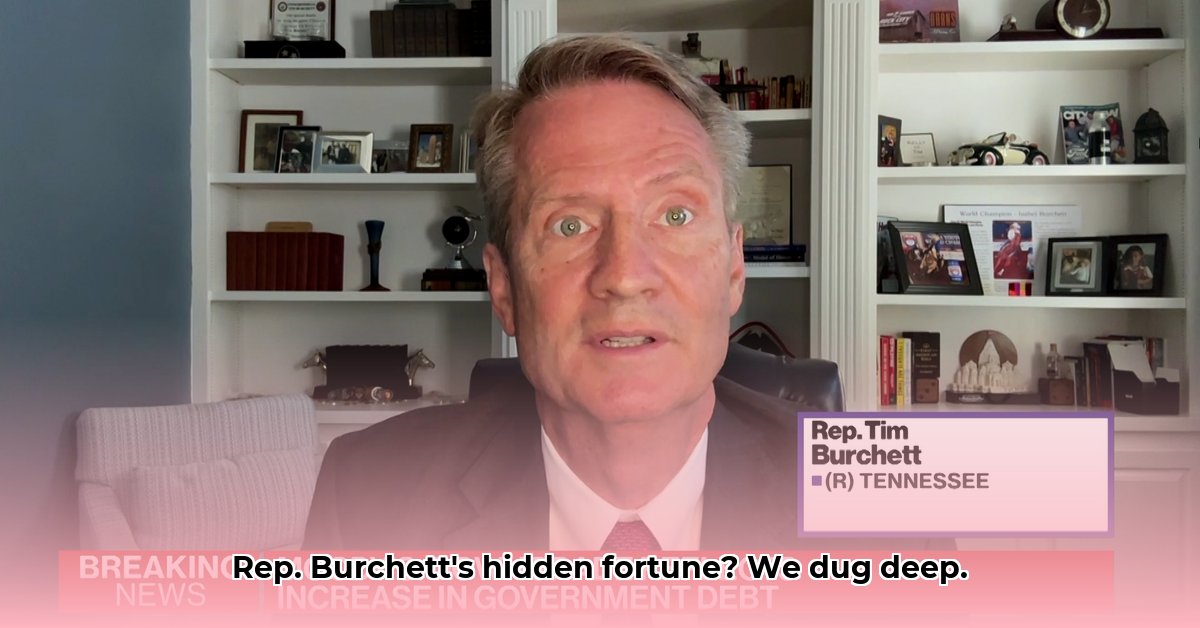
Congressman Tim Burchett of Tennessee has served as mayor, state legislator, and now U.S. Representative. While his career suggests substantial earnings, determining his precise net worth proves surprisingly challenging due to a significant lack of transparency in publicly available financial information. This analysis explores the difficulties in assessing his wealth, compares his disclosure practices to broader trends in American politics, and proposes solutions to enhance financial transparency. For more information on his finances, see Burchett's net worth.
The Elusive Net Worth: Challenges and Methodology
Precisely calculating Congressman Burchett's net worth is hampered by limited publicly available data. Online sources offer varying estimates, ranging from one million to nine million dollars, but these lack sufficient documentation to validate their accuracy. This study relies primarily on publicly accessible information, including but not limited to official government records and campaign finance disclosures. However, the inconsistent and often incomplete nature of this data significantly limits the potential for precise calculation. We acknowledge the inherent limitations of this approach. Further investigation beyond the scope of this analysis would be necessary to confirm any specific financial figure.
Examining Burchett's Career: Income Sources and Data Gaps
Congressman Burchett's career progression provides some clues, but obtaining exact figures remains difficult. His salaries as mayor, state representative, state senator, and U.S. Representative represent significant income streams. Unfortunately, obtaining precise salary figures for each position across different years requires navigating fragmented government websites and records, making a comprehensive calculation of his combined earnings – and therefore, a calculation of his net worth – extremely challenging. While we can infer likely salary ranges based on typical compensation for these positions, these are broad estimates, not precise figures.
Comparative Analysis: Transparency Across Politicians
The difficulty in assessing Congressman Burchett's finances isn't unique. Many American politicians operate under financial disclosure rules that, despite their existence, often prove vague and inconsistently enforced. A direct comparison to other politicians' financial transparency is hampered by this inconsistency. While some might argue he's representative of many elected officials facing similar reporting limitations, others see this lack of clarity as a significant problem demanding attention. A substantial comparative study would require extensive research beyond the scope of this piece.
Ethical and Political Implications of Financial Opacity
The lack of complete financial disclosure raises ethical concerns. Without full transparency, evaluating potential conflicts of interest that could influence decision-making becomes significantly more difficult. This lack of easily accessible information erodes public trust and undermines confidence in the democratic process. How can citizens hold their representatives accountable without a clear understanding of their financial affairs? It’s not simply about Burchett; it’s about systemic issues impacting public trust in government.
Toward Greater Transparency: A Call to Action
Several steps are needed to improve transparency and ensure public trust:
Strengthen Financial Disclosure Laws: Legislation should demand more detailed and verifiable financial reporting from politicians, requiring precise valuations rather than broad ranges and mandating electronic filing for easier access and analysis. (Efficacy: potential for significant improvement in data quality and accessibility).
Enhance Enforcement of Existing Laws: Stronger enforcement mechanisms and penalties for non-compliance are needed to ensure politicians adhere to existing disclosure requirements. (Efficacy: improved compliance rates are likely, leading to more complete data).
Independent Audits of Disclosures: Independent, third-party audits would increase accountability and verify the accuracy of reported financial information. (Efficacy: enhanced accuracy and reduced likelihood of misrepresentation).
Create User-Friendly Public Databases: Centralized, readily accessible databases, making financial information easily searchable, are crucial. (Efficacy: greatly enhanced public access to information fostering greater transparency).
The need for greater transparency in political finance isn't merely a matter of satisfying curiosity; it's essential for maintaining public trust and ensuring ethical governance. Congressman Burchett's case serves as a stark reminder of the ongoing struggle to achieve this vital goal. Further research and continuous monitoring are necessary to hold our elected officials accountable and build a more transparent political landscape.